When choosing an outsourced steel detailer, ask for evidence that matches the claim being made. A company’s quality procedure, an individual’s credential and a proposed project assignment answer different questions. Record the named holder, the subject covered and the information still needed before treating a general qualification statement as support for your package.
For a US fabricator, this review sits alongside defining the drawing scope and price. It helps the purchasing and detailing teams ask a supplier specific questions about its checking process and proposed people. The project requirements and your company’s supplier-review process determine what evidence is needed and who evaluates it.
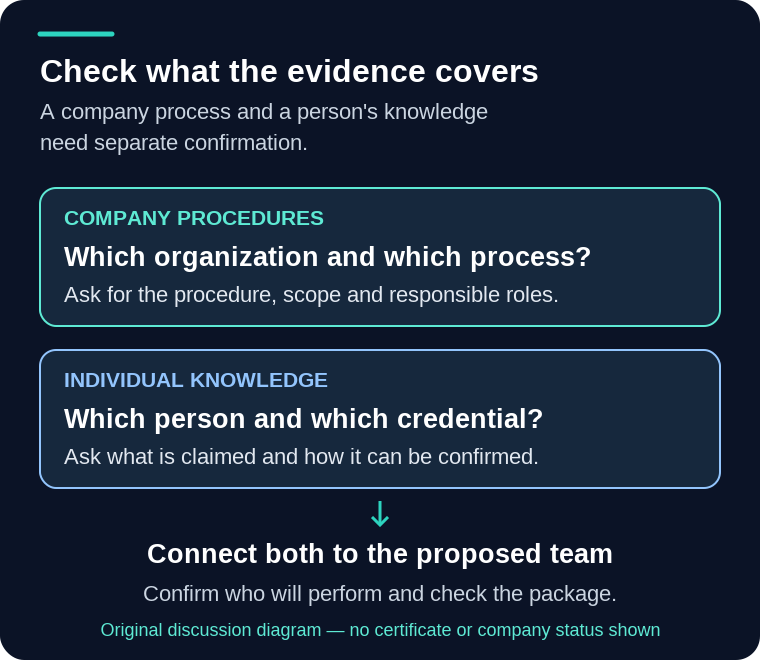
Separate company procedures from individual knowledge
The National Institute of Steel Detailing describes its Quality Procedures Program (QPP) as a program for detailing firms’ quality assurance procedures. Its published checklist addresses checking personnel, review of revisions and clarification of design problems. Those are useful subjects to discuss when a supplier describes its quality process.
NISD’s Individual Detailer Certification (IDC) addresses an individual’s detailing knowledge. When this credential is offered, identify the person and the stated discipline or classification. Then ask how that person relates to the team proposed for your package. A personal credential and evidence about company procedures have different subjects.
Use the issuer’s current information to clarify a program claim. Ask for the holder’s name, the applicable program and scope, and an appropriate way to confirm the claimed status. Avoid assuming that a logo, association membership or an unnamed training reference answers all of those questions. This guide does not establish any supplier’s certification or make a program a universal requirement for every project.
Ask how checking will work on your package
Move from a general quality statement to the proposed workflow. Ask the supplier to explain who develops the drawings, who checks them and who handles an unresolved design question. Request a description of how comments are returned to the author and how completion of the check is recorded.
A useful discussion identifies the checking role for the work you are buying, including any work prepared by another office or subcontractor. Ask what happens if the proposed checker becomes unavailable. Keep the answer as a staffing or procedure statement to evaluate, rather than assuming that the person named in a brochure will perform the work.
For example, a supplier may name a quality program and describe its staff’s qualifications, while leaving the checker for your first package undecided. That is a concrete question to return before selection: which role is confirmed, which remains proposed and who will confirm the assignment? The supplier’s response should fit your required scope and review process.
Use samples and references for a defined purpose
Ask for a permitted redacted sample or an original demonstration relevant to the work under discussion. State what your team wants to assess: drawing communication, the relationship between outputs or the supplier’s explanation of its checking process. Ask the supplier to identify what it prepared and the limits of the sample.
A finished sheet may show presentation, but it does not identify who checked it, which work the supplier performed or whether that team is available for your package. A model image also leaves the receiving shop’s file requirements open. Use a sample to guide specific questions, with technical evaluation assigned to the appropriate people in your organization.
For comparable-work references, ask which part of the work the supplier performed and whether the reference may be contacted. Arrange any exchange of client documents through an authorized channel. If permission or role information is missing, leave that part of the evidence review open. A generic portfolio image should not become an invented client result in your supplier record.
Worked example: three claims still needing clarification
The following record is fictional. It contains no real supplier, person, certificate, client drawing or project outcome. The entries describe incomplete statements supplied for discussion; none has been independently verified. They are not a pass/fail scoring system or a required qualification standard.
Scroll the table sideways to read every follow-up question.
| Claim to review | Information received | What stays open | Question for the supplier |
|---|---|---|---|
| Company checking procedures | A staff training profile is supplied in response. | The profile concerns a person; it does not describe the firm's checking procedure. | Which procedure describes checking, comment resolution and the responsible roles? |
| A qualified checker is proposed | The supplier describes an individual's credential but gives no assignment statement. | The credential claim needs its own confirmation; the person's proposed role is also unconfirmed. | Who is proposed to check this package, and how can the stated credential and role be confirmed? |
| Comparable work experience | A finished drawing image is supplied without role or permission information. | The supplier's contribution, reference availability and permission to share are unknown. | What work did your team perform, and can you provide an authorized reference or demonstration? |
The first row is an evidence-type mismatch: a person’s training profile does not describe the firm’s process. The second separates two checks that can easily be combined incorrectly: the credential claim and the proposed assignment. The third keeps a portfolio image separate from confirmation of the supplier’s contribution.
Keep the unresolved item beside the claim. Recording a program name, receiving a document and completing your supplier evaluation are separate steps. Return an open item to the person who can supply the missing information; do not fill it with an assumption about competence, capacity or approval.
Send a focused evidence request
Adapt this original request to the qualification subjects your team actually needs to review. Share personal information and client material only through the agreed private channel.
Proposed detailing package:
Qualification claim being discussed:
Named company or individual the claim covers:
Program / credential / procedure reference, where applicable:
Information supplied and date:
What our team needs to confirm:
Proposed author and checking roles:
Supplier's responsible contact / response reference:
Open item and next action:
Ask for a response against each open item. If the proposed team or scope changes, identify which answers need to be revisited. Retain the response reference so the people evaluating the supplier can distinguish confirmed information from a statement still awaiting clarification.
Keep qualification, quotation and release checks connected
This evidence review helps you evaluate the supplier and proposed team. Once the work is defined, use the separate steel shop drawing RFQ checklist to align deliverables, work boundaries and pricing assumptions. Its worked quote comparison supports that separate decision.
After award, the shop and erection drawing release guide addresses the files received for an identified package. Supplier qualification does not replace that document check, the project’s technical review or its authorization process.
To discuss steel fabrication drawing services, describe the package, expected outputs and the review responsibilities your team needs to establish. You can also review the shop drawing service scope before sending a scoped inquiry. Include the qualification subjects and proposed assignments your team needs to confirm.